
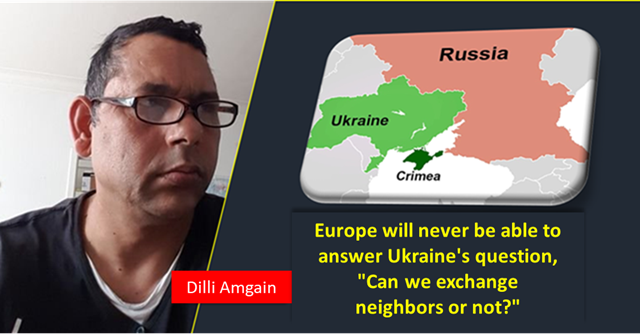
After the dissolution of the Soviet Union, the Western powers planned to further weaken Russia and seize the natural resources within the Soviet republics. That is why they showed no interest in adhering to the agreement not to expand NATO into the former Soviet states and, after the dissolution of the Soviet Union, continued to expand NATO into the former Soviet Union.
✍ Dilli Ram Ammai
Those who comment on the rulers of any country without understanding history are either ignorant fools or robots who have already made up their minds. When commenting on any country, it is essential to understand the geographical location and history of that country clearly. For good relations with neighboring countries, plans for cooperation with neighboring countries are decided by assessing the security interests and economic and strategic situation of the country concerned. Currently, the relations between the Eastern European countries of Ukraine and Russia are in a dangerous state due to the war. There are multifaceted advantages and disadvantages in the relations between these two countries, which Ukraine is facing when it does not respect, the country is facing the consequences of war.
Viktor Yanukovych, who became the President of Ukraine in 2010, was impeached under Western pressure after he refused to damage relations with Russia by rejecting the proposals of the European Union and the entire West. After the so-called coup d’état, funded and directed by the West, overthrew Yanukovych, Alexander Turkmenov and Petro Poroshenko took power. Ignoring Russia’s security concerns, they pursued NATO membership and even the European Union. At that time, Turkmenov and Petro Poroshenko brutally murdered about 14,000 Russian-speaking people living in Crimea and the eastern region of Ukraine. Crimea’s regional autonomy was taken away. The Russian language was removed from the Russian-majority region. In that situation, it was not unusual for the security concerns of the emerging superpower Russia to increase. Only after these events did Russia take Crimea under its borders by completing the legal process. It may be an understatement to say that this is the only seed of the current war, so an attempt has been made here to dig into the ancient history of Ukraine, which will help to understand the bridges of their social and regional concerns.
History of Early Slavic Civilization:
The large East Slavic state was incorporated into Kievan Rus’ (Kiev-controlled Rus’) in the 9th century. Historians believe that it was founded by Oleg, the ruler of the then Novgorod province. First, Oleg captured Kiev. Kiev was made the capital of Kievan Rus’ due to its strategic importance on the banks of the Dnieper River. In 860-862, the East Slavic and Finnic tribes (including the Chuds, Slovenes, Krivichs, Merovingians, and Ves) ‘went to war with the Varangians.’ The Slavs won the war and drove the old rulers beyond the sea and began to rule themselves.’ Later, the tribes began to fight each other, and Rurik decided to invite the Varangians back. Rurik, along with his brothers Sineus and Truvor, arrived in Kiev with a large army. They brought anarchy under control and expanded the state. The Rurik dynasty ruled Kievan Rus’ until the 10th century. Prince Vladimir the Great (Ukrainian: Принц Володимир) became the standard-bearer of Kievan Rus’ Golden Age.
In 988, Vladimir the Great converted to Orthodox Christianity, marking the beginning of the conversion of Kievan Rus’. Local deities and natural religions were destroyed. This paved the way for the spread of Orthodox Christianity to the East.
In the 11th century, the heyday of Yaroslav’s rule reached its peak. During this time, Kiev became an important political and cultural center of Eastern Europe.
At the beginning of the 13th century, several cities were destroyed by the Mongol invasion of the Russian state. The Mongol invasion of 1237–1240 ended Kiev’s traditional power. After this, the Tatars, descendants of the Mongol king Golden Horde, established their empire (khanate) near the northern shores of the Black Sea.
Crimea was part of the Crimean Khanate from 1441 to 1783, until it was annexed by the Russian Empire by order of Catherine the Great. The war was fought for Slavic civilization, but it has a special significance in European history. In those days, people living in European countries considered Russia to be an invincible power.
After the Bolshevik Revolution:
In the first phase of the Russian Civil War, after the collapse of the Russian Empire in 1917, a series of short-lived independent governments (Crimean People’s Republic, Crimean Regional Government, Crimean Autonomous Oblast) began to adapt to the Soviet model, with their autonomy. The territorial units of the old Russian Empire, namely the Russian Empire, joined the Russian Federation after the Bolshevik Revolution.
In October 1921, the Bolshevik Russian Federation took control of the entire peninsula and established the Crimean Autonomous Soviet Socialist Republic as a member of the Russian Federation. The following year, Crimea joined the Soviet Union as part of Russia (RSFSR).
After World War II in 1944, the Soviet government stripped all of the autonomy of the indigenous Crimean Tatars. In 1954, the Crimean Oblast was transferred from a Russian province to a Ukrainian province. In 1989, under Gorbachev’s perestroika, the Supreme Soviet declared Stalin’s deportation of Crimean Tatars illegal and allowed the mostly Muslim ethnic group to return to Crimea.
In 1990, the Crimean Autonomous Oblast Soviet proposed the restoration of the Crimean Autonomous Oblast. In 1991, a referendum was held in the region, asking whether Crimea should become a union republic. However, by then the Soviet Union was in the process of disintegrating. Crimea was restored as a Ukrainian region for less than a year before Ukrainian independence was restored. Ukraine retained its autonomous status as a new state.
In May 1992, the regional parliament proclaimed an independent “Crimean Republic”. In June 1992, Ukraine and the Crimean Autonomous Government reached an agreement to remain part of Ukraine with both autonomous rights. The leader of the Russian-speaking movement, Yuriy Meskov, was elected President of Crimea in 1994, and his party won a majority in the regional parliamentary elections that same year. The conflict between the Ukrainian government and Crimea worsened between 1992 and 1995. The pro-Russian movement weakened due to internal disagreements, and in March 1995 the Ukrainian government dissolved the Crimean government and assumed autonomous powers. All local rights in Crimea were abolished.
On August 24, 2009, Russian-speakers organized anti-Ukrainian demonstrations in Crimea. Russian-speakers were in the overwhelming majority in Crimea. Therefore, Ukraine did its utmost to suppress these movements.
After Viktor Yanukovych, who is considered close to Russia, was elected as the president of Ukraine in 2010, Ukraine stopped its repression of Crimea. It began to treat Russian-speaking and Ukrainians equally. In 2013, Ukraine rejected the European Union’s proposal to open its market to Europe. The West was trying to drag Ukraine into the proposal and take action against Russia. Yanukovych could not have misunderstood this. When Europe rejected the proposal, the Western-backed Pink Movement began to overthrow Yanukovych. Unable to cope with the situation that arose, Yanukovych sought refuge in Russia. After President Viktor Yanukovych was overthrown, Russian troops arrived in Crimea, Ukraine, to protect Russian-speaking people.
The events that took place in Kiev to overthrow Ukrainian President Viktor Yanukovych on February 22, 2014, led to pro-Russian and anti-separatist demonstrations in Crimea. At the same time, Russian President Vladimir Putin discussed the events in Ukraine with his security chiefs, suggesting that “we should start the process of returning Crimea to Russia.” On February 27, 2014, Russian-speaking militants seized strategic locations across Crimea. However, Russia initially denied any military involvement. After Russian-speaking protesters seized the Crimean parliament, it dismissed the Crimean government, installed a pro-Russian Aksyonov government, and announced a referendum on Crimea’s status. The referendum resulted in an overwhelming majority in favor of joining Russia. The next day, March 17, 2014, Crimean authorities declared independence and requested to join Russia. Russia formally annexed Crimea on March 18, 2014. Following the annexation, Russia maintained a military presence on the peninsula and warned that any external intervention would be unacceptable.
Ukraine and its Western allies condemned the annexation of Crimea, calling it a violation of international law and Russian agreements to protect Ukraine’s territorial integrity. After the annexation, the G8 members suspended Russia from the group and imposed hundreds of sanctions. The West’s ulterior motive was to make Ukraine a member of the European Union and NATO and to station its naval, air, and land forces on Russia’s borders, which Russia understood. The UN General Assembly also called the referendum and annexation unnatural and passed a resolution requiring Russia to justify it.
Ukraine’s annexation to Russia is considered to be the suppression of the Russian-speaking population of Ukraine and the abolition of Crimea’s autonomous rights. This can only be understood after reading the full history of Crimea. Superficial analysis of the geopolitical situation of any country blinds the reader’s curiosity. Therefore, a good writer should not do that.
Finally, after the dissolution of the Soviet Union, the Western powers planned to further weaken Russia and seize the natural resources within the Soviet republics. That is why they did not show any interest in adhering to the agreement not to expand NATO into the former Soviet states and, after the dissolution of the Soviet Union, continued to expand NATO into the former Soviet Union. They also wanted their puppet government in Ukraine. They continued to work systematically to prepare for that. In recent times, they secretly poured more investment. They used media propaganda to weaken Russia. They created hundreds of INGOs and bought Ukrainian employees, leaders, and media, as in Georgia. They created an environment for war with Russia by abandoning the Minsk Agreements of 2014. Finally, they worked hard to win the victory of Volodymyr Zelensky, a populist comedian of Jewish origin, who was born from their investments, and finally made him the president of Ukraine. Zelensky continued to plan to enter NATO. Which foolish ruler invites the enemy to his doorstep without considering Russia’s security sensitivities? A puppet like Zelensky was ready for that. This was the reason why Russia launched a military operation in Ukraine.
Western media is reporting that George Soros, the alleged propaganda chief of the Western Deep State, spent nine billion dollars to make Zelensky president and make him a member of NATO. US Republican leaders are making various facts public and speaking. From these facts, it can be easily understood what the West was trying to do in Ukraine, what the Russian operation was for.
It is being reported in the Western media that George Soros, the alleged propaganda chief of the Western Deep State, spent nine billion dollars to make Zelensky the president and make him a member of NATO. Republican leaders in the US are making various facts public. From these facts, one can easily understand what the West was trying to do in Ukraine, what the Russian operation was for.
Europe or the West is not helping Ukraine out of compassion. It is the Western media that is telling us that NATO has come to Ukraine to plunder Ukraine’s rare mineral resources and to gradually embroil Russia in war. Former German Chancellors Merkela and Macron have already publicly stated that the Minsk Agreement was not made for peace but to prepare Ukraine to fight Russia. Keir Stimmer and Macron have made it clear at the UK and Brussels summits that Ukraine must provide unconditional support, as it is now fighting for its own territory, not its own territory, but for the Western alliance. It is now clear that France and Britain, like the US, have a serious interest in Ukraine’s natural resources.
A Western-planned war is underway in Russia-Ukraine. The war imposed in the name of Western hegemony and security concerns has already claimed the lives of about one million people. Various media outlets have reported that a total of 3,122,713 million Ukrainian currency equivalent in revenue and 834,951 million Ukrainian currency equivalent in expenditure have been spent. Western media outlets have reported that Ukraine has spent 64,753 million US dollars on the military alone. US President Trump has already told Zelensky the same thing in the Oval Office. Various figures show that the US alone has provided 7.5 billion dollars, Britain has provided more than 2.2 billion pounds, and NATO and its partner countries have provided a total of 100 billion dollars.
If only a few percent of this money spent on killing the Ukrainian people had been spent on the welfare of the Ukrainian people, the situation in Ukraine today would be different. If he had governed in a balanced manner by addressing the security concerns of his neighbors like Mongolia, Belarus, and other Asian neighbors, Zelensky’s country would not have faced a security crisis, nor would he have had to keep on asking the West to “take my minerals” with a paper in Trump’s loss-making deal. Zelensky would not have had to be reprimanded by the US during the “Oval talks.” The country would have become rich by selling those minerals. The country turned to ashes when it followed the behest of others. If you ask who made Ukraine like this, Zelensky is now in a position to say, “Yes, it is him.” The situation of poor Ukraine, when the country is being sold piecemeal and the country is being sold in piecemeal agreements, it is impossible to say whether the Ukrainian people will have anything left or not. Europe is still inciting Zelensky to go to war to satisfy Ukraine’s hunger, but Europe will never be able to answer the question, “Can Ukraine be exchanged for a neighbor or not?” Hail, self-respect!

प्रतिक्रिया