
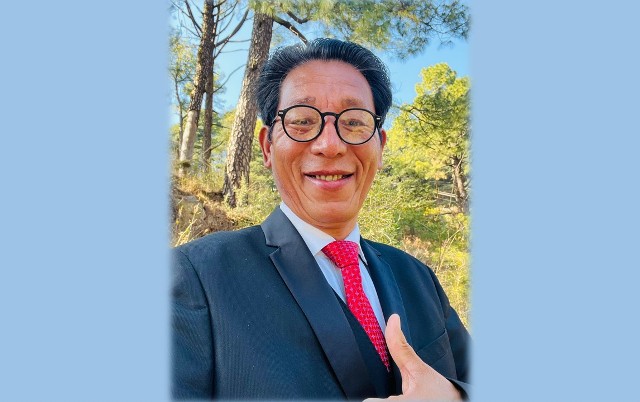
As Nepal moves into the charged atmosphere of parliamentary elections, another, quieter political process is unfolding alongside it. Within the Tibetan refugee community living across Nepal and India, preparations are underway to elect the head of their government-in-exile, based in Dharamshala in India’s Himachal Pradesh.
This year, four candidates are competing for the role. Among them is Ngawang Gaden, who fled China two decades ago, traveling through Nepal before eventually reaching India. Known within the refugee community for his moderate stance, Ngawang is often described as a proponent of a “middle-path” approach rather than an advocate of hardline positions. He has publicly expressed support for China’s territorial integrity and sovereignty, a position that sets him apart in a deeply divided political landscape.
In the following conversation, Ngawang speaks about his journey, his political outlook, and the challenges facing Tibetan refugees today. The interview was conducted by Ghatana ra Bichar.
- Could you tell us about your background and the events that preceded your departure from China?
- I am a Rinpoche (Living Buddha) jointly recognized by the Chinese government and the Dalai Lama. I studied at the Beijing Tibetan Language Higher Buddhist Academy and the Minzu University of China, majoring in religious philosophy. On December 19, 2007, I opposed the Chinese government due to my religious beliefs and interests. At 2:00 AM on December 29, 2007, I went to a prison in Yunnan and served 1 year and 6 months in that prison. In December 2009, I illegally fled from China to Nepal.
- Could you shed some light on your journey from Tibet and what led you to become an advocate for the Dalai Lama’s approach to the Tibet issue?
- On January 10, 2010, I fled from Tibet to India. At that time, I met with the Dalai Lama, who told me that since 1974 he had stopped advocating for Tibetan independence and instead pursued a “middle-path,” primarily aimed at protecting Tibetan religion, culture, language, and environment. Therefore, he asked me to support his middle-path to gain a favorable attitude from the Chinese government. For the past 17 years, I have been promoting the Dalai Lama’s middle-path, especially through online and other channels, to relevant Chinese government departments. The Dalai Lama’s stance on the middle-path is that it proves Tibet will not separate from China.
- How would you describe your political stance on Tibet, and how do you think your views affect your chances of being elected the leader of the Tibetan government-in-exile?
- My political stance is centrist; I advocate for “one country, two systems” within the framework of the Chinese government’s policies, without seeking Tibetan independence, and I oppose Tibetan independence activities. I am unlikely to be elected as the political leader of the Tibetan government-in-exile at present because Tibetans born abroad do not like people like me, and because I oppose interference by the United States and Western countries in Tibet’s political and social stability, democracy, human rights, and religious issues.
The government-in-exile and separatists incite Tibetans in Tibet to self-immolate against the Chinese government. Separatists have been misleading the honest people by saying that if they commit such self-immolations, they can receive financial support from the United States and other Western countries.
- What motivated you to participate in this election, and what outcomes do you hope to achieve through it?
- My main reason for participating in this election is to improve relations between the Dalai Lama and the Chinese government, and to seek an opportunity for the Dalai Lama to visit Tibet and the Tibetan region.
- How will the winner of this election be determined?
- The winner will be announced by the Election Commission of the Tibetan Government-in-Exile.
- What are your thoughts on the self-immolation protests occurring within Tibet?
- The influence of Tibetan separatist politics abroad on Tibetans’ self-immolation protests against the Chinese government within Tibet is something I personally believe they do not wish to do. However, the Tibetan government-in-exile and non-governmental Tibetan separatist organizations encourage Tibetans inside Tibet to self-immolate and protest against the Chinese government in various ways. They believe that protests by Tibetans inside Tibet could garner funding from the US and Western governments.
- How does the Tibetan government-in-exile sustain itself financially?
- In recent years, US government aid to the Tibetan government-in-exile has decreased significantly, while aid from other Western governments has been almost nonexistent. This is because the Chinese government has a very large international influence. Consequently, the US, China, and Western countries and governments have improved relations with the Chinese government on economic and other issues.
- Has the Chinese government maintained any form of dialogue or contact with the Dalai Lama?
- Since the Dalai Lama handed over political power to the people through elections in 2011, he has had no relationship with the Chinese government, which considers it unnecessary.
- How safe do you feel in India?
- Since November 2022, I have faced significant threats to my safety from the Tibetan government, NGOs, and Tibetan separatists, but Indian security personnel and police have shown great concern for me. Therefore, my safety is generally considered adequate.
- What do you see as the future of the Tibetan government-in-exile?
- The Tibetan government-in-exile has no opportunity to engage in political activities in India and Nepal regarding Tibet, because India and Nepal are on China’s borders, and their national security interests will not support the Tibetan government-in-exile’s political activities. One day, after the Dalai Lama passes away, the Tibetan government-in-exile will naturally close down or dissolve.
I advocate one country, two systems, but it must be under the policies and arrangements of the Chinese government. I disagree with the concept of an independent Tibet.
- Do you believe the Tibetan government-in-exile may not receive any support from the Indian government to ensure its continuity?
- The Tibetan government-in-exile has been established in Dharamshala for 68 years, but the Indian government has never publicly supported Tibet’s political issues. If the Dalai Lama were to pass away one day, the Indian government would not be able to continue the Tibetan government-in-exile.
- What do you anticipate will happen after the Dalai Lama passes away?
- After the Dalai Lama’s death, the Tibetan government-in-exile will naturally dissolve. The Indian and Chinese governments will strengthen their strict enforcement regarding the Dalai Lama’s reincarnation.
- What is your perspective on the reincarnation of the Dalai Lama?
- The Dalai Lama’s reincarnation will occur in India, not elsewhere. I won’t elaborate further on the Dalai Lama’s reincarnation; please understand.
- What are your plans for the coming years, and how has your experience in India been?
- I am 60 years old this year, and if my health permits, I will continue to work here to help the poor and needy Tibetans both inside and outside Tibet. I really enjoy living in India; it allows me to learn about the United States and Western countries and their governments.
- What are your aspirations for the future of Tibetans living in China?
- I hope that the lives of Tibetans within China will become increasingly better, and that their culture, language, beliefs, human rights, democracy, and religion will all flourish.

प्रतिक्रिया